History of John Cooper (1834-1922)
How we are related:
John Cooper (1834-1922)
Isabel Cooper Speakman (1867-1934)
William Daniel Speakman (1896-1928)
Daniel Vaughn Speakman (1919-1999)
(Some of the information in this blog post comes from documents posted on FamilySearch Family Tree in the Memories section of John Cooper's profile page - a letter from John Cooper to his daughter May Ann Cooper Davies posted by Ronald Wayne Leavitt, a history written by John's daughter Emily Cooper Johnson, etc)
Fillmore, [Utah], September 10, 1918
My dear children, I received your letter a few days ago, was pleased to get it and to hear from you. ... With regard to the information you desire, I note the following:
My father, James Cooper, was born in Loughborough, Leicestershire, England, May 24, 1811. My mother [Ann North] was born in the same place [Kegworth, Leicestershire, England] in February [27 January] 1811. Their work is done in the Salt Lake Temple.
My grandfather, John Cooper, was born [30 June 1765] in Sevenoaks, Kent, England. My grandmother [Mary Laxton] was born [4 November 1776] in [Leicester,] Leicestershire, [England], her maiden name was Mary Laxton. [They had] Eight children, Mary, Thomas, Charles, John, William, James, George, and Betsy. I brought their history from England in 1882 and left it with your mother [Mary Ann Lewis Cooper], and when I came home it could not be found.
My grandfather, John North, was born in the same place we were [5 May 1785, Knightthorpe, Leicestershire, England]. Also his wife, Mary North [11 July 1790, Kegworth, Leicestershire, England], she did not change her name. Her maiden name was North, but not relatives. They had a large family: Elizabeth, Ann, John, William, Catherine, Thomas, Caroline, George, Betsey, Mary, Eliza, Oliver, and Emma. Their [temple] work is done in St. George by William North.
I [John Cooper] was born May 27, 1834 in Loughborough [Leicestershire, England]. I was married to your mother [Mary Ann Lewis] October 1861 in the Endowment House. Was first married to her in Salt Lake, June 8, 1857.
John Cooper's Letter to His Daughter, Mary Ann Cooper Davies, 10 September 1918
 |
| John Cooper Christening Record |
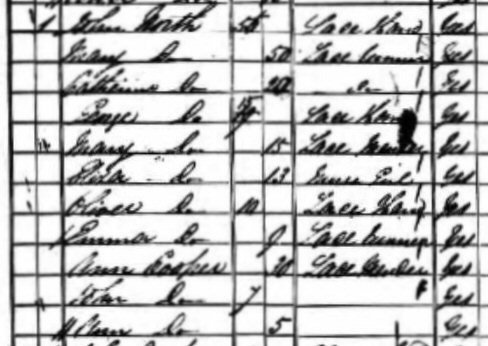
John Cooper, son of James and Ann North Cooper, was born in Loughborough, Leicestershire, England, on May 27, 1834, and christened in November. His father died in a train accident when he was two years and nine months old. In 1841 Ann and her two children were living in the North household.
 |
| 1841 England Census |
 |
| North Family in 1841 England Census |
 |
| Ann North Cooper |
But conditions became such that his mother could not take care of both John and his younger sister Mary Ann, so she eventually let John's Uncle Charles Cooper take him to raise.
His uncle Charles was a bachelor at the time and had a great deal of this world's goods, so it is reported that he gave John many advantages that other children could not have, such as a good education. A pencil at that time cost 25 cents, and books and writing paper were very expensive. However, other family recountings say that he had only "a few weeks of night school in England." His uncle did see that he learned a trade whereby he could also make a living. Anyone learning a trade in his day had to be an apprentice for seven years before he could go out on his own. John's was the shoemaker trade, and he was very adept and clever at making and mending shoes. John's daughter Emily remembered, "He made us girl’s nice velvet house shoes and also made shoes for people that were crippled." But John did not particularly enjoy this vocation, so as time went by he almost gave it up and later made a living as a farmer and mechanic. At one time in his life he was offered a spot in Salt Lake (where the Walker Bank stands) to put up a shoe shop and practice his trade but he turned it down.
 |
| 1851 England Census |
A cordwainer (/ˈkɔːrdˌweɪnər/) is a shoemaker who makes new shoes from new leather. The cordwainer's trade can be contrasted with the cobbler's trade, according to a tradition in Britain that restricted cobblers to repairing shoes.
John was a nice looking man with brown eyes and dark wavy hair. He stood 5 feet 10 inch tall and weighed between 160-170 pounds. He was very athletic and took part in all kinds of sports of his day. He was one of the fastest foot racers in England, and after winning one race, he was presented to Queen Victoria. He was musically inclined and did a great deal of singing with the young people in England.
His family belonged to the Church of England and, like all the people of that time; they followed the religion of the ruling Monarch. When he was in his teens, John and some of his companions were walking down a street in England when they saw a crowd gathered on a corner. The boys went to investigate and saw two young men preaching and singing. They stopped to listen awhile. At first they were not very impressed. When they left the crowd they made up a parody to the song they heard, but the words of the preachers and of the song kept ringing in John’s ears and he couldn’t erase them from his mind, so he found himself sneaking out as often as he could to hear these preachers. He found they were Mormons, and their message rang so clear that he investigated their religion and joined the Mormon Church, and in so doing was turned out of his uncle’s home and disinherited. Family tradition is that his uncle never spoke to him again.
John was baptized on November 5, 1850 by Langley and ordained an Elder by Henry George in 1852. He labored as a missionary from 1854-1856. At this time John met Mary Ann Lewis who was a friend of his sister, and through his efforts she was converted to the Gospel and baptized. Her family was also unhappy about her decision to become a Mormon, so after John and Mary Ann became engaged to be married they decided to go to America and gather with the Saints.
Compiled From
HISTORY OF JOHN COOPER by his daughter, Mrs. Emily C. Johnson on September 3, 1957
and other biographies on FamilySearch Family Tree - John Cooper's Profile Page
In 1856 at 21 years of age, John and Mary Ann Lewis left England to sail to America in the ship Enoch Train. After a six week voyage, they landed in Boston, Massachusetts, then took a train to Iowa city where the rails ended.
 |
| The Enoch Train - Liverpool to Boston, 23 March 1856 to May 1866 |
You can read about the crossing here:
THE LDS MILLENIAL STAR
No. 23, Vol. XVIII
HISTORY OF ELLEN RUSSELL
The First Handcart Company - Report from the SS Enoch Train
They were assigned to an ox train lead by Captain William Hodgetts where John performed the task of driving an ox team. The ox train started across the Great Plains with the Edward Martin handcart company, but because the group got a late start, they eventually left many of their goods along the trail to lighten their loads so they could get to Utah faster. When they were caught by early winter storms, they had few blankets or warm clothes and little food. They suffered in the cold and snow until those who survived were rescued at Devil's Gate by men bringing wagons and supplies from Salt Lake to assist them.
You can read about the William B. Hodgetts Company here:
https://history.lds.org/overlandtravel/companies/148/william-b-hodgetts-company
The leaders of the group ask for volunteers to stay and guard from Indians the goods cached at Devil's Gate that could not be taken to the valley until spring. John and twenty other men, were left during the winter of 1856-57. Mary Ann came on to Salt Lake with the wagon train, reaching the city December 11th. Her legs and knees were black as a chimney back from frost bite, and she also was snow blind. President Young sent her to a woman to be taken care of until she was well.
Dan Jones who had been chosen as the leader of the volunteers, called the men together and told them if there was a man among them who felt that he could not eat the last poor animal, hide and all, suffer all manner of privation and hardship, he would give them a last chance to go on with the company, but not one man faltered; they all voted to stay. They were given twenty days worth of supplies, but as it turned out, they had to remain there five months. The winter for the men left behind was hard. They were snowed in until spring with very little food and clothing.
The men could not go out hunting alone, because the Indians were very unfriendly. A man by the name of Redick Allred was sent from Salt Lake City with flour and other precision for the men at Devil's Gate. He got as far as South Pass and was told by the people there that his trip would be in vain as no man could survive the cold and hunger that those men were forced to face and that he might as well turn back because he would surely find them all dead, so he turned and went back to Salt Lake City.
But these men were stalwart and full of faith. John told his children many times how they night herded the cattle to keep the wolves from attacking them until the danger of the wolves attacking the men became too great. The cattle became so poor and were dying so fast that they killed them to save them for food. One man among them was an expert butcher and he prepared the meat expecting to eat only the best and keep the rest for wolf bait, but the wolves didn't get any of it. The men were obliged to eat every bit of it themselves, even the hides and hoofs. They suffered with cold and hunger, and they dug under the snow for onions and segoes. The raw hides were scalded to take off the hair and cooked and eaten to keep off starvation. Brigham Young thought they had received the provisions he had sent with Allred, but in reality they were in starving condition and many of them were very sick because of eating rawhides. John said their constant prayer was that God would bless their stomachs and adapt them to the kind of food they were forced to eat. When help finally arrived they had their saddle straps soaking preparing to cook. The men were so thin they could hardly walk. John went in weighing about 160 pounds and came out weighting 80 pounds. John with other men came onto Salt Lake valley on June 1857 with the wagon train that had come to their relief.
Daniel Webster Jones (August 26, 1830 - April 20, 1915) was an American and Mormon pioneer
Jones was among the first who left in search of the missing handcart companies stranded on the plains of Wyoming. “The company found the Willie Handcart Company near South Pass. After reaching Devil's Gate, they still hadn't found the other groups, and Jones, Joseph A. Young, and Abe Garr were sent ahead to find the missing parties and help them in to the Devil's Gate area. After assisting them to a spot now known as Martin's Cove, it was determined that Jones, Thomas Alexander, and Ben Hampton would remain behind with the goods cached at Fort Seminoe, together with 17 teamsters detailed from the Hunt and Hodgett wagon companies. They were left to face five winter months in Wyoming, hundreds of miles from help, with scarcely anything to eat, and under conditions of extreme privation. Imagine the sacrifice! Offers were made to each man to join the wagons bound for the valley, but every one of them chose to stay behind, obedient to the call to serve.” That winter was recorded as one of the most severe ever. The intrepid watchmen struggled to repair the cabins at Devil's Gate; killed the remaining cattle; stored the tough, stringy beef for food; and reconditioned and stacked the goods they were left to protect. They killed a few buffalo, but the hunting became bad. At one point Dan Jones was literally preparing to eat his own saddle! “The men did the best they could with what they had…Dan prayed to know how to prepare the rawhides to make them edible.” He wrote: Finally, I was impressed how to fix the stuff and gave the company advice,…scorch and scrape the hair off; this had a tendency to kill and purify the bad taste that scalding gave it. After scraping, boil one hour in plenty of water, throwing the water away which had extracted all the glue, then wash and scrape the hide thoroughly, washing in cold water, then boil to a jelly and let it get cold, and then eat with a little sugar sprinkled on it. This was considerable trouble, but we had little else to do and it was better than starving. We asked the lord to bless our stomachs and adapt them to this food. We hadn’t the faith to ask him to bless the raw-hide for it was hard stock….We enjoyed this sumptuous fare for about six weeks. They ate all the hides, leather wagon tongue wrappings, old moccasin soles, as well as “a piece of buffalo hide that had been used for a foot mat for two months.” By February, they were out of everything. After their monthly fast day (which was truly a day without food), Dan was impressed to “tell the men to correct any wrong doings among themselves, clean up and pray to the Lord, saying “[The Lord] would take care of us, for we were there on His business,” and if they would all do as I advised we would have a good clean supper of healthy food. They washed out their storehouse and presented it before the Lord empty, but clean, and then they waited...Evening came on and no supper; eight o’clock, no word from anyone…Between eight and nine o’clock all were sitting waiting, now and then good-naturedly saying it was most supper time. No one seemed disheartened. Soon they heard noises outside. It was the mail company trying to get through the area…The visitors had food to share and by this miracle, starvation was once again avoided. Several times during the winter, Dan and his men received food from Indians and others that helped to sustain them,” including a visit from a member of the Snake Indian tribe who came to their camp loaded with good buffalo meat. The winter passed, and finally, early in May, the relief wagons began to roll in. Of the various communications Brother Jones received, one critical letter from Brigham Young had not arrived. Loading and shipping of the stored goods could not commence without it. For days they waited, becoming increasingly anxious. Finally Brother Jones sought the Lord in prayer to know how to proceed. He recorded the following testimony: "Next morning without saying anything about the lack of instructions we commenced business. Soon someone asked whose teams were to be loaded first, [and] I dictated to my clerk. Thus we continued. As fast as the clerk put them down, orders would be given, and we passed on to the next. We continued this [way] for four days. . . . All the teams were loaded up, companies organized and started back [to the valley]" (Daniel W. Jones, Forty Years among the Indians [1960], 107). The 17 young men were loaded on the last wagons departing to the Salt Lake Valley, where they would be reunited with their families and loved ones. Brother Jones arrived later to report to President Young, feeling not a little uncertain how he would be received. Should he have waited for the President's written orders? As everything unfolded, it was learned that President Young had indeed dictated a letter of instructions, which was never received. Dan carefully presented his detailed report. It was a testimony to him to find that the inspiration he'd received in Wyoming was exactly the same as in the prophet's letter. Dan Jones's young men had done more than they ever would have imagined they could: They had crossed the plains in wagons and by handcart, mostly on foot. They had seen many of their friends and relatives die along the way. They had volunteered to spend the winter 300 miles from their destination. They had survived a harsh winter with little food and few, if any, comforts. They had heeded the call of the prophet to serve their fellow Saints. They had endured to the end nobly and were blessed for their efforts.
Read more here:
Mary Ann waited for John to arrive in the spring, and two days after he came they were married - June 8, 1857. They were later sealed in the Endowment House in Salt Lake city on October 9, 1861.
They were called to go to Fillmore, Millard, Utah, where their first house was a dugout in the Old Fort. John went to Deserert for a while with his family to help build the dam, then moved back to Fillmore and build a permanent house. Here they raised eight children: John Lewis, Mary Ann, Charles W, James Henry, Isabella, Franklin, Arthur, Florence May.
John was an excellent penman and whiz in arithmetic, adding large columns of figures in
seconds. John was also a good gardener, having one of the best gardens in town. He loved animals, always kept a buggy and team of horses for pleasure, and a riding pony for the two boys.
John was the first shoemaker in Fillmore and belonged to one of the first bands there. John led the choir at every funeral held in Fillmore when he was alive. He was superintendent of the Sunday school for eight years, acted was ward chorister for eight years, was city Councilman for one term, city water master four terms, Millard County Treasurer 5 terms. Justice of the Peace 2 terms, Millard county Clerk and Recorder 2 terms. He was even called into homes to help men who were under the influence of liquor.
He went among the sick administering to them and giving of his earthly substance. There was never a funeral held in Fillmore while he was alive but what he preached or prayed and always led the choir. He was even called into the homes to quiet men who were under the influence of liquor.
He also held many important offices in civil life. He was City Councilman, Deputy County Clerk, County Treasurer for 6 terms or twelve years, and a member of the School Board. He was City Water Master many years.
People always found him ready to help in time of trouble and a never-ending source of good cheer in time of sorrow or discouragement. He was a peaceful, generous man who liked to dance and was interested in all kinds of sports. He had a keen mind, enjoyed reading, and was a good public speaker.
The 1860, 1870, and 1880 U.S. Federal Census records show John's growing family living in Fillmore, Millard, Utah Territory, United States. In 1860 he gives his occupation as farmer, in 1870 as shoemaker, and in 1880 as boot & shoemaker.
"When he first came to Fillmore he lived in the Old Fort. His second son, William, was born in this fort. He bought one of the first Charter Oak cook stoves.
“I remember him telling of the hardships they had when he first came to Fillmore. How the crickets devoured everything and sometimes they never had enough flour in the house to make bread until they went to the fields and gleaned a little wheat here and there and ground it. Sugar was a luxury, but with all his troubles and hardships he never became bitter and tried to bring happiness wherever he went.
"He fought in the Indian War, or Black Hawk War, under a Captain Callister. This captain did not keep a very good record and what was kept was lost for a number of years, but was found after father died so he never received a pension for his services in that war.
There were several John Cooper’s and they were all claiming to be the right one so it was not until these records were found that they discovered father was the right one.
At one time during this war, father was sent out to scout around to see if any Indians were prowling around. Some of the Indians caught him, slashing him across the knee with a tomahawk. Then they took him and his horse to their camp. Father thought they were going to finish him, but instead they dressed his knee and took care of him and his horse until he was able to return to the fort. After that he and the Indians always remained good friends and he did much to keep peace with the red men and white settlers."
History by Emily Cooper Johnson
John’s mother, Ann North Cooper came from England to Fillmore to live the last years of her life. She had met and married Mr. Goddard and she became known as Grandma Goddard and also as “Little Grandma”.
Grandma Goddard had been a great lace maker. She could take an ordinary spool of thread, split the thread and could make a bird, a flower or other decorations in a plain curtain. In later years when Mary Ann sewed, Grandma Goddard would sit in the arm chair and thread the needles for her as she sewed. Grandma Goddard would darn the stockings and little thing of that sort. She was only 26 years of age when her husband, James Cooper, died.
One time a very funny thing happened to Grandma Goddard. She always wore a white nightcap and Mary Ann’s son, Frank had a little horse called Blue that he had trained to take off his cap for him. Grandma Goddard went out to the toilet one night and as she was coming back to the house, she screamed, “A man, a man...” It was the horse that had come up behind her and tried to pull off her cap.
 |
| Ann North Cooper |
John fulfilled a mission to England again in 1880-1882, presiding over Leeds, Nottingham & London Conferences. Before he left Utah, the possibility of his bringing home another woman to be a polygamous wife must have been discussed, because John Leon Davies recorded:
"Mary Ann and John’s two oldest children were grown up and married when John decided to go to England on another mission in 1880. Mary Ann still had 5 children at home ages about 7 to 17. She told John that if he married another wife in plural marriage, she would not welcome him when he returned."
Blah
 |
1881 England Census
“While on his mission he stayed at the home of George & Emily Newbold who kept what was called a “Conference House”, where the members who departed stayed. There he met Sarah Ann Kate Newbold. They were married 13 July 1882 or 1883 (accounts vary) in the Endowment House. An indexed Utah Marriage Record gives the date as 1892, but this is surely an indexing error or an after-the-fact ceremony. Kate and her father came to America in 1881. This wife lived in Wyoming and Idaho until April 1892, when, after the death of Mary Ann in late October 1891, he moved Kate and 4 children to Fillmore. Seven children were born to them. He had little formal education. Just a few weeks of night school in England. He read and studied to gain knowledge to help himself and others. He did many menial jobs to support his family. Jobs such as driving a freight wagon collecting milk for delivery to the creamery, etc.
Kate Newbold Cooper
July 14, 1900 his second wife died, leaving 7 children. The eldest was 14 years old and the youngest was 3 months. John Cooper was then 77 years old. There was no grandmother or grandfather. All the Aunts and Uncles lived out of the state so this man had to raise his family alone. He had offers to give his girls away but he said, “No, my children will be raised together”. The eldest girl was 13 years old. She had to take care of the baby. She had to be the mother in the home."
Autobiography of Amy Gee
This is the 1900 U.S. Census taken in Fillmore on June 11, 1900 - the month before Kate Newbold Cooper died:
In 1902 John married Clara Judson (Mace), widow of George Mace. She died in June of 1921 and John followed in March of 1922.
The entry for John Cooper in the "LDS Biographical Encyclopedia" is interesting, but some of the information is obviously incorrect. He did not go out from Salt Lake, for example, to meet the Martin & Willie handcart companies as he was there in Hodgetts' wagon train:
John Cooper
in the LDS Biographical Encyclopedia
Name: John Cooper
Gender: Male
Father: James Cooper
Mother: Ann North
Comments: Cooper, John, president of the High Priests' quorum in the Millard Stake of Zion, Utah, is a son of James Cooper and Ann North and was born May 27, 1834 in Loughborough, Leicestershire, England. He was baptized Nov. 5, 1849, by Elder Langley Algood, was ordained a Priest in 1851, an Elder in 1852, a Seventy in September, 1857, by Hyrum Mace, and a High Priest in February, 1894, by Francis M. Lyman. He labored as a missionary in 1854–55 in England, mostly in the Leicester and Sheffield conferences. He filled another mission to England in 1880–82. At that time he traveled in and presided over the Leeds, Nottingham and London conferences. Among the many positions filled by him at home may be mentioned that of president of Seventies, superintendent of Sunday school, choir leader, Ward clerk, Ward teacher and home missionary. He has married three wives, with whom he has had sixteen children, fourteen of whom are still alive. Of civil offices Elder Cooper has served as a member of the city council in Fillmore, water master, deputy county clerk, county treasurer, member of the Fillmore school board etc. Otherwise he is a boot and shoemaker by trade and has also followed farming and gardening. His permanent residence is in Fillmore, Millard county. In 1856 he was detailed to meet and follow up the belated hand-cart companies. While out on this expedition he was called to stop at the Devil's Gate, together with nineteen others, to protect the property of the emigrating Saints. He remained there all winter. As a member of the Nauvoo Legion he did military duty during the Blackhawk War and holds a medal for bravery during his Indian campaigns.
|
Rogers, Sadie. East Millard Pioneers, Death Notices, As Published in the Progress 1913-1937:
The Millard County Progress, Friday, 17 Mar 1922:
JOHN COOPER DIES AT AGE OF 88
John Cooper, Fillmore's oldest man died last Tuesday night at the home of his son Frank. Had he lived until next May he would have been 88 years old. At his death he was the oldest man living in Fillmore.
His funeral will be held Friday at 2 P.M. A full account of the funeral and a sketch of his life will appear in the next issue of the Progress.
The passing of Brother Cooper leaves Hans Rasmussen, age 86, as the oldest man in Fillmore. Christian Anderson and Mr. Cummings are also octogenarians,aged 82 respectively. Mrs. King is probably the oldest lady in town, being something over ninety years old. Mrs. Allen Russell is also somewhere about ninety.
The passing of any of these stalwart pioneers who spent their lives to build the foundations of present opportunity causes us to pause and bow the head in reverence.
* * * * *
The Millard County Progress, Friday, 24 Mar 1922:
FUNERAL SERVICES FOR JOHN COOPER HELD
Funeral services were held at the Ward Chapel last Friday over the remains of John Cooper, an account of whose death was published in the Progress last week. Bishop Parker Robison of Fillmore presided. The choir furnished the music with special numbers by a male quartet. Mrs. F. H. Partridge gave the opening prayer. The speakers were Peter L. Brunson, F. A. Robison, and T. C. Callister. Benediction was pronounced by Asael Fisher. The grave was dedicated by F. A. Robison.
Mr. Cooper, the son of James and Ann North Cooper, was born in Loughborough, Leicestershire, England, May 27, 1834.
In 1856 Mr. Cooper left England in the ship Enoch Train, and crossed the plains in Captain William B. Hodgett's company as far as Devil's Gate, where he, together with about 20 other men, were left during the winter of 1856-57 to watch the goods cached there by late emigrants of '56. The next spring he came on to Salt Lake and then came almost direct to Fillmore,where he has since lived.
Mr. Cooper has filled two missions, one in 1854-55, before he left England, and again to England in 1880-82, presiding over Leeds, Nottingham and London Conferences.
Mr. Cooper has filled many ecclesiastical positions, among them ward clerk, superintendent of Sunday School, choir leader, president of seventies, and counselor to the president of the stake high priest's quorum.
Mr. Cooper also held important offices in civil life, including city councilman, deputy county clerk, county treasurer, and member of Fillmore school board. He also served in the Indian War.
He married Mary Ann Lewis, June 8, 1857, with whom he had eight children, six of them are living. Mrs. Cooper died Oct. --, 1891. He married Sarah Ann Kate Newbold, July 11, 1882. By this union seven children were born, six of whom are living. She died in July, 1900. In 1902, Mr. Cooper married Mrs. Clara M. Judson, and she had also preceded him to the great beyond dying in July, 1921.
Mr. Cooper is survived by the following children: William and Frank Cooper, Mrs. May Stevens and Mrs. Isabel Speakman, Fillmore; Arthur Cooper, Aurora; George Cooper, North Ogden; Nelson, Fred, and Ben Cooper, Provo; Mrs. Amy Gee and Mrs. Emily Johnson, Ephraim; also 64 grandchildren and 60 great grandchildren.
Mr. Cooper was spoken of by the speakers at the funeral as a man of many friends, one of the best loved men who has lived in Fillmore. He was a man of good cheer and a confirmed optimist. People always found him ready help in times of trouble and a never-ending source of good cheer in times of sorrow or discouragement.
He was a man of great physical endurance and courage. During his service in the Black Hawk War he won a medal for bravery. In the trying times of the terrible winter at Devil's Gate, when he and the twenty men he was with were reduced to a diet of raw hide, he showed great fortitude and stamina.
He lived his religion well and his upright life was a source of inspiration to all who knew him. He was a lover of children and was never too busy to give them attention and a good word. Nor did his interest in them cease after they grew older and he died rich in lasting friendships.
He had all the qualities of a pioneer and he took an active part in the pioneering of Fillmore and Deseret. After living at the latter place for a few years, he returned to Fillmore, where he has lived ever since.
Although 87 years old at the time of his death, he looked and acted much younger and was active both mentally and physically up to the time of his demise. Up to the time of his eightieth year he held the office of county treasurer, which position he filled efficiently for twelve years preceding.
He will be greatly missed in Fillmore and the town which he helped to build will always owe him a debt of gratitude.