Followers

Wednesday, March 30, 2016

A Shelter From the Storm

A Shelter from the Storm
28 March 2016

       I have been blessed with wonderful men in my life.
Men who were examples of hard work, dedication, faith, fun, and love.

My Dad and Uncle Weldon Johnson
Growing up, the most important man, of course, was my father, Vaughn Speakman.
One of my earliest memories of him is when I was about four years old and we lived in the little town of Aspermont in West Texas. 


Easter in Aspermont - Sue & Nancy


My sister and I were small and our family lived in a little rented house.

Christmas in Aspermont

Nancy's band-aide was for her small pox vaccination. 

 In the spring in West Texas there would be thunderstorms and sometimes tornadoes.   I remember one night when there was a lot of thunder and I couldn't sleep.  When the telephone unexpectedly rang, my father answered it and spoke to someone. After he hung up he told my mother that there was a tornado warning and we all needed to go to a storm cellar.  There were several families in town who had “storm cellars” and when there was a tornado warning everyone in town would gather to one of these cellars.


My sister and I were already in bed, so my parents wrapped blankets around us and carried us down the street to the back of the neighbor’s lot. 


Asleep in Aspermont

 The cellars would be out in the yard, not part of the house.
You entered by double doors that would be opened out on a slant just above the ground.   
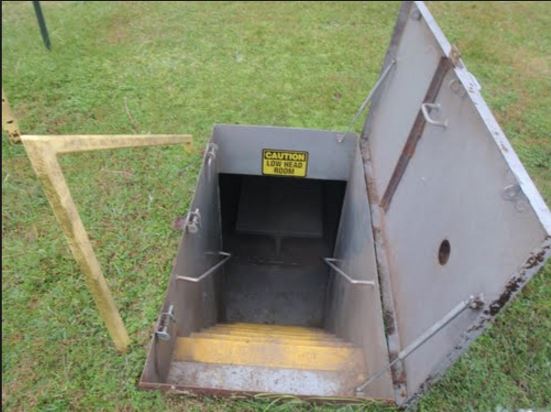
Similar Storm Cellar

We went down the cement steps (which often had spiders) and spread blankets out on the floor of the cellar.  The children slept or played, the women visited, but the men stood outside and watched the clouds.  Occasionally my dad would come down the steps to report on the weather and check on us to see if everything was all right.  He had rain spots on his shirt and I was worried about his staying out where it was dangerous.  My mother told me not to worry, that the men would come in and close the cellar doors if they saw a tornado.

This was my first impression of what it meant to be a man and a father.  He carried me out of harm’s way.  He watched for danger.  He stood between the storm and me.  I knew from this experience that when I faced any kind of  “storm” in my life,  he would be there for me and I could trust him.

My dad cared about my physical, mental, and spiritual welfare.
He was always there to counsel and support me..

In Brownwood he organized a little dependent Sunday School to give us the opportunity to attend church and learn the gospel principles, taking on the responsibility of finding a meeting facility and organizing meetings.  He eventually had to leave his job in Brownwood because of religious persecution from his boss.
This, however, turned out to be a blessing in disguise - he got a better job in Fort Worth and our family was able to attend a real ward, resulting in my mother being baptized.

Brownwood Dependent Sunday School

In Fort Worth, when he served as bishop of the Fort Worth Ward, he took on the extra duty of teaching seminary one year when no one else was available, so that the teenagers in the ward would not miss a year of seminary instruction.  Looking back on those times in later years he marveled at what he was able to accomplish.  "I don't know how we did it," he remarked.  
"We were certainly blessed."


Fort Worth Ward Bishopric - 1962

His example has informed my understanding of my Heavenly Father.
He also stands between the storm and me.  He also cares a about my welfare.
He is there when I seek his counsel.

Psalm 46:1-3
1 God is our refuge and strength, a very present help in trouble.
 2 Therefore will not we fear, though the earth be removed, and though the mountains be carried into the midst of the sea;
 3 Though the waters thereof roar and be troubled, though the mountains shake with the swelling thereof. Selah.


My father was an advocate for women, believing that they should have all the advantages of men,
including as much education as they desired and any job they were qualified for.
It always upset him when he met a man who would not send his daughters to college "because they were only going to be housewives."

Fort Worth House

His faith and courage strengthened him at he dealt with life's problems and with the physical challenges he faced in later life.  He always stood and faced the storm, knowing there was an eternal shelter at his back and a dawn beyond the dark clouds and howling winds of the black night.


Colonel Vaughn Speakman


Monday, March 21, 2016

Cerena Jordan Little 1818 - 1900

Cerena Jordan Little 1818 - 1900

How we are related:
Cerena Jordan Little
Emily Virginia Little Pittman
May Ellen Pittman Brewer
Ina Beatrice Brewer Johnson
Marion Allen Johnson Speakman


Cerena (Cerene, Serena) Jordan was born on June 11, 1818, in South Carolina.  Her father was probably the Garret Jordan who is listed in the 1840 U.S. Census of Chambers County, Alabama.  There are 8 white persons and 12 slaves listed in the inventory.  In the 1850 and 1860 census records Garret’s wife is listed as Mary.  This is Mary Atkinson, whom Garret married in 1844 in Chambers County, but Cerena’s mother is assumed to be Garret’s first wife Lucy.

Cerena married Asa Little, who was 15 years her senior, on June 11, 1838, in Chambers County, Alabama, with the consent of her parents. Some records give the date as June 6, but that was probably the day they obtained the licence.

The Nixburg Community - Coosa County, Alabama
In 1832 the town of Robbinsville became Nixburg, after Charles William, Absolom and Ambrose Nix, whose families settled there.  People settled around NIxburg more rapidly than other parts of the county.  By the 1840's, among those early settlers were: ... Asa, James, and Robert Little ...


Ten children can be documented as having been born to Asa and Cerena and two others are listed by Beeman Family genealogists from family records, corroborating Cerenea's statement in the 1900 U.S. Census, when she was about 82 years old, that she was the mother of 12 children, 3 living.

1.  F - Letha Ann Little - 1839-?
2.  M - Franklin Greenberry Little - 1840-1880
3.  M - Robert Little - 1842-1864
4.  F - Lucy Little - 1844-1895
5.  F - Nancy J. Little Steele - 1846-1928
6.  F - Edna Susan Little - 1848-1863
7.  F - Martha Rebecca Little Beeman- 1850-1925
8.  F - Mary Elizabeth Little - 1852-1873
9.  F - Emily Virginia Little Pittman - 1854-1888
10. M - Asa Little - 1856-1862
11. U - W. E. Little - 1859-1859
12. M - Hudson Little - 1862-1864

Those still living in 1900 would have been:
1.  Martha Rebecca Little Beeman
2.  Nancy J. Little Steele
3. ? Unidentified - probably Letha Ann since she is the only one left without a death date.

In 1866 Asa and Cerena left Alabama for Texas, settling in the community of Retreat in Navarro County.

RETREAT
The community known as Retreat was first called Beeman’s School House.  In the early days of Navarro County this community was settled by the Beemans, Hamilton, Picketts, Bishops, Highnotes, Pettys, Hammonds, Hodges, McElwees, Clarkes, White, Martins, Comperes, Simmons and Asa Littles.  The school house was located on the Beeman land and it was also used as a church by various denominations on Sunday.  For a long time the old log school house was the only church or school near Corsicana to the Southwest.  This building was moved, due to shifting of population, two or three miles Southwest of its original location and was later moved back across Harris Branch.  Due to these frequent moves someone suggested that the name Retreat would be apropos and this designation has been used until this day.

Record of Marks & Brands 
1854 - 1873
Navarro County, Texas
Little, Asa - April 16, 1867
Little, James - May 29, 1855

Asa died in 1871 and by 1880 Cerena was living with the family of her daughter Emily V Little in Ellis County, Texas.  Twenty years later in 1900 she was still living in Ellis County, but with her grandson, Nat Brewer, her daughter having died two years earlier.

Cerena died on December 22, 1900, in Navarro County, Texas, at the age of 82.  She, along with other family members, are buried in the Hamilton-Beeman Cemetery in Corsicana, Texas.  Pictures are from Marion Hudson.

Little Burial Plot
Stack of stones on right is Asa's grave.  Broken stone to the left is probably Cerena's gravesite.

Part of Asa's Tombstone


Among the oldest cemeteries in Navarro County is Hamilton-Beeman Cemetery, located southwest of Corsicana near the community of Retreat.


Cerena's Stone

How we are related:
Cerena Jordan Little
Emily Virginia Little Pittman
May Ellen Pittman Brewer
Ina Beatrice Brewer Johnson
Marion Allen Johnson Speakman

Sunday, March 20, 2016

Guarding the Temple

20 March 2016
In celebration of the dedication of the Provo City Center Temple today.


"LET THE MOUNTAINS SHOUT FOR JOY!  LET THE VALLEY SING"


Guarding the Temple


The Fresno Temple was dedicated on a beautiful spring day in April 2000, but during the cold winter months preceding, as it neared completion, the builders took down the construction fence in order to finish the exterior walls and erect the decorative enclosure. During the several weeks it would take for the decorative fence around the temple to be assembled and completed, the construction site would be vulnerable to intruders, and Roger Lambert, who was a member of the Stake High Council, was assigned to organize protection for the area during the night hours. 

A man was to be stationed in the parking lot between the Stake Center and the temple from evening until morning, and the men signed up for shifts of 2-3 hours throughout the night. If any man’s replacement didn’t show up for the assigned shift, Roger received a phone call from the person on duty and would go over to guard the temple himself. The men sat in their cars with their heaters running or wrapped in blankets or coats to keep warm.  Roger would listen to the radio to help keep himself awake.  These men guarded the temple to prevent destructive acts that could delay the blessings from the Lord anticipated by the Saints in the area.  The men of the priesthood made sure the temple was never left unprotected.

It gave me a good feeling to think about the priesthood brethren guarding the temple.  This showed me that these priesthood bearers loved God and respected His house.  It was the same feeling I got when my father stood with the men of Aspermont, Texas, watching the sky during a tornado alert. 

Roger remembers attending the dedication of the Los Angeles Temple when he was a boy and we have witnessed many temple dedications since.  They are always a time for great rejoicing.  

President Monson has said:

The world can be a challenging and difficult place in which to live. We are often surrounded by that which would drag us down. As you and I go to the holy houses of God, as we remember the covenants we make within, we will be more able to bear every trial and to overcome each temptation. In this sacred sanctuary we will find peace; we will be renewed and fortified.

Why are so many willing to give so much in order to receive the blessings of the temple? Those who understand the eternal blessings which come from the temple know that no sacrifice is too great, no price too heavy, no struggle too difficult in order to receive those blessings. There are never too many miles to travel, too many obstacles to overcome, or too much discomfort to endure. They understand that the saving ordinances received in the temple that permit us to someday return to our Heavenly Father in an eternal family relationship and to be endowed with blessings and power from on high are worth every sacrifice and every effort.

APRIL 2011 | The Holy Temple—a Beacon to the World


Tuesday, March 8, 2016

Mary Ann Anderson McBride


Mary Ann Anderson McBride (1815-1896)

How we are related:
Mary Anne Anderson McBride
Helen Venera McBride Colgrove
Minnie Colgrove Ashby
Martha Geneva Ashby Speakman
Daniel Vaughn Speakman


Mary Ann Anderson McBride


          The youngest of 10 children, Mary Ann Anderson was born on March 25th, 1808 at Stafford, Genesee, New York, to parents who had recently come from their native Chesterfield, Massachusetts. She married Reuben McBride on September 23rd, 1830 at Villenova, Chautauqua, New York. Reuben's deceased father had been a Cambellite minister and his mother Abigail Mead McBride led her entire family into the L.D.S. church in 1833 after they were taught the gospel by William Cahoon, Amasa Lyman, and Evan Green.
Reuben and Mary Ann A. McBride

            In the spring of 1834, on March 4th, Joseph Smith and Parley P. Pratt came to the McBride home and held a meeting.  At the close of the meeting, Joseph called for volunteers to go up to redeem Zion. Reuben was the first who volunteered to go. He and his brother-in-law Vinson Knight arrived in Kirtland, Ohio, on April 21st.  The pregnant Mary Ann and one-year-old Helen V. waited in New York. Following his release from Zion's Camp, Reuben returned home, probably arriving in August, perhaps in time for the birth of his second daughter, Harriet on August 31st.  Mary Ann joined the "Mormons" over the protests of her family and left them all behind as she followed the Saints west.
       
          Reuben was ordained a member of the Second Quorum of Seventy on 14 February 1835.  In the spring of that year the McBride clan sold their farms and traveled to Kirtland, Ohio, to gather with the saints.  The trip was made by stagecoach and canal boat and took about 6 days.
The McBrides donated liberally to the building of the city of Kirtland and to the temple. With six of her children, Abigail - the matriarch of the McBride clan - enjoyed the heavenly manifestations given at the dedication of the Kirtland Temple on March 27, 1836.

          In Kirtland Mary Ann was left alone with her children much of the time because Reuben was considered by the church authorities as a minute man and did a great deal of missionary work.  While at Kirtland, the following children were born to them: Reuben, Louisa, Roy, Emma, Newton, and Laura. Some family trees list a son James who was born in 1848 and died in 1851, but if he existed, he is not enumerated with the family on the 1850 U.S. Census.  Unfortunately for our record keeping, Mary Ann died a few years short of the 1900 U.S. Census which would have listed how many children she had borne.


          In 1850 Reuben traveled to Utah in company with President Brigham Young in whose family he made his home the following year.  He returned to Kirtland in 1851 to prepare his family for the move West.  Reuben again entered the Salt Lake Valley in 1852 with the Isaac Bullock company, this time with his wife Mary Ann Anderson and their 8 children: Helen Venera, Harriet Eliza, Reuben Augustus, Mary Louisa, Hyrum Roy, Emma Jerutia, John Newton, and Laura Abigail.  They spent the winter in Farmington and Springville. Some time later, after moving to Fillmore, their baby Alice came, making a family of six girls and three sons.  Records show that a daughter Anna was born in 1857 in Fillmore and died in 1865.

   
Mary Ann's granddaughter wrote of her:

          "Grandma McBride was a woman of culture and skill. She was Poetic, contributing many poems to the public. For many years she contributed to the "Womans Exponent," the first Relief Society magazine published in Utah, each issue of which she prized very highly, keeping them filed for future reference. She was full of benevolence and kindness to the poor, contributing much of her time and talent without solicitation or compensation. God blessed her with a talent to bring and save souls. By her kind hand, many souls were brought into the world under various critical conditions. God being her guide, she achieved great success. For several years she was counselor in the Millard Stake Relief Society and later President of the Fillmore Ward Relief Society. She was very skillful in needle-craft. As a child I remember seeing some of her excellent work, which was sent to the State Fair.
          I well remember a beautiful bed spread which she wove of navy blue and white fine yarn. The design was a real piece of art. She would put her spinning wheel up stairs where she thought it would be safe, but on the contrary, the grand children would find their way to Grandmothers spinning wheel and try their talent at making yarn from rolls.
           Grandmother's loom was an ideal hiding place for the children to seclude themselves while deeply engaged in study. Grandmother used to make a variety of dyes with which she would color pieces for quilts and rags for carpets. She also made soap from hard wood ashes. Grandfather made her what they called a leach which was composed of slats of wood, then filled with hard wood ashes and a trough for a drain. About once a day she would pour a bucket of water over the ashes. When sufficient liquid had accumulated she would add a certain amount of grease and make soap which served for washing, scrubbing, etc.
          Besides rearing her family of nine children she raised the youngest son of her daughter Laura who died at the age of 26 years, leaving six small children. Although the family did not suffer for food as some of the early pioneers did, yet they indulged in all the labor incidental to pioneer life, spinning yarn, weaving the cloth from which she made clothing for her family.
          Grandma was always true to her faith. Not only did she desire to care for the living, but also for the dead. She and Grandfather did much work at the St. George and Manti Temples. After the death of grandfather, grandmother remained in their own home for some time.
When her health began to fail, she went to live with her youngest daughter, Mrs. Alice Callister, where she remained until her death, August 18, 1896 at Fillmore, Millard County, Utah."


Patriarchal Blessing

given to Mary Ann Anderson McBride

Fillmore, Millard, Utah
March 16th, 1895  (age 80)


Fillmore, March 16th, 1895. A blessing by John Ashman, Patriarch, upon the head of Mary Ann McBride, daughter of Alanson and Priscilla Anderson, born at Stafford, Genesee County, New York.


Sister Mary Ann McBride, by virtue and authority of the holy priesthood vested in me and my high and holy calling, I lay my hands upon your head and seal upon you a patriarchal  blessing by which your lineage shall be made known unto you. Thou art of Joseph through the loins of Ephraim and are entitled to all the blessings pertaining to the new and everlasting covenant. Thy Father in Heaven blessed thee to come forth in the dispensation of the fullness of times and had your name written in the Lamb's book of life, and because of thy faithfulness, it shall remain there through all eternity. Thou hast passed through many scenes of trouble and persecutions but thy Father in Heaven has sent his angels that have guarded thee and sustained thee and thou hast kept the faith. Henceforth there is laid up for thee a crown of celestial glory. I say unto thee, sister be comforted in thy mind, for thy children shall be saved through thy faithfulness in the Kingdom of God. Thou shalt stand upon Mount Zion with thy husband and thy children shall gather around you, and not one shall be lost. Thy last days shall be thy best days and when thine hour is come, thou shalt depart in peace, surrounded by thy family and friends. And holy angels shall guard thee to the realms above, when thou shall meet with thy loved ones and be welcomed by the prophets of God that have preceded thee. And I seal thee up to eternal life to come forth in the morning of the first resurrection, clothed with immortality and eternal life. And I seal upon you all your former blessings and a crown of celestial glory, in the name of Jesus Christ, Amen.


Fillmore, Utah, Cemetery

How we are related:
Mary Anne Anderson McBride
Helen Venera McBride Colgrove
Minnie Colgrove Ashby
Martha Geneva Ashby Speakman
Daniel Vaughn Speakman


BIOGRAPHICAL WIKI (on the Internet Archive Wayback Machine)
https://web.archive.org/web/20140401161129/http://biographicalwiki.com/index.php/Mary_Ann_Anderson_%281814-1896%29

FINDAGRAVE.COM
http://www.findagrave.com/cgi-bin/fg.cgi?page=gr&GSln=McBride&GSiman=1&GScid=77228&GRid=25781247&

Many details are taken from an article in the Territorial Statehouse State Park in Fillmore, Utah.

Monday, February 29, 2016

She's a Real Chick

She's A Real Chick


This is a story of mortification and humiliation.  It’s a funny story, but it wasn’t so funny at the time.

My sister Nancy and I attended East Ward Elementary School in Brownwood, Texas.
At the time of this story, she was in first grade, I was in third.  It was a great school.  I loved walking into the building the first day of every school year and being greeted by the wonderful familiar smells of waxed floors, chalk dust, and new crayons.  Each classroom had a bank of windows across the outside wall and wooden lockers for each student across the back.


          Our desks had spaces for ink bottles and the lid lifted to store our books.  Outside was an endless grassy playground with a few swings and other play equipment, but we girls spent a lot of our time playing with balls and jumping ropes.  We would check out the balls and big ropes from a supply closet.  We also brought jacks and, sometimes, tops and marbles from home.  We enjoyed sports like baseball, but play could be difficult because we wore only dresses and it took more organizing.


Doodle Bug Hole
          Nature also provided diversion on the playground.  There were usually doodle bug holes in the soft dirt where you could pester the little creatures into coming up and showing themselves.  Sometimes you could catch a horned toad, but you had to be careful that it didn’t spit on you.  In the spring there might be swarms of monarch butterflies, and on a hot day you would sometimes find tarantulas in the outside water fountains.  If a ball went over the fence someone had to go gingerly though the cactus in the vacant lot to retrieve it.
        The school had an auditorium with a stage and I got to be Cinderella in my class Christmas play. My mother added a long skirt to a ballet tutu for my costume.  Across the back of the auditorium were a few shelves with books that constituted the “library.”  We were allowed to go there on Fridays and check out books.  Often I would crawl into bed with my book after dinner on Friday and read until I finished it.  I liked Pippa Longstocking books, Miss Pickerell books, and The Bobsey Twins.

Cinderella

Principle-Mrs. Wilson, Sue Anne, Teacher-Mrs. Friend
          This incident happened in the spring.  In fact, it was Easter.  The first grade was putting on an Easter play during the school holiday and the first graders were excited because it was their first time on the stage in the auditorium. When my mother took Nancy to the school for the performance, I went along.  Nancy had to be there early to get into her costume and when we arrived in the first grade classroom, there was a buzz of activity.  Little Easter critters filled the room, and Nancy hurried into her costume.  

          There was also a little hum of concerned voices among a group of mothers, and I soon found out why.  The “chick” was not able to be there.  My mother hurried over to me.  She wanted me to be the chick!  I was the only extra child available and since I was small, I could probably squeeze into a first grade costume.  Besides, the chick only had to say one line, she assured, so I agreed to be the chick. It shouldn’t be hard and might even be fun.

Not me, but similar
          They handed me the chick costume - and then I got the bad news.  I had to change right there in the classroom.  The play was about to start and there was no time to go anywhere private.  I balked. I was not stripping down to my underwear in front of all those first graders! The solution the mothers came up with was not a big improvement.  Several made a circle around me, held out their skirts, and instructed me to change.  “No one can see you now,” they chirped.  It didn’t feel very private to me with several women peering down at me, but I could see there was no way out, so I quickly squeezed into the chick costume, which was pretty skimpy - like a bathing suit that tied around the back of the neck - and two sizes too small.
I was given instructions about my one line and when to say it.  I stood on the stage with everyone else in my skimpy costume trying to anticipate the moment when I should speak up.  But I had never even seen this production and I didn’t have a feel for the flow, so I’m afraid there was a deadly silence that lasted several seconds while everyone else on stage looked at me expectantly.  My sister nodded meaningfully and I self-consciously spurted out my one line.

To the adults, this was not even an occurrence to be given a second thought.  To the first graders, it was an oddity to have a third grader in their play.  But my classmates howled with good-natured glee as they teased me the first day back at school.  They had all heard about my humiliation - that I was in the first grade play - in a skimpy chick costume!

Easter Togs
.

These are the directions to one of our playground games.
SEVEN UP
Single Person Bouncing Ball Game

Equipment:
Small rubber ball or tennis ball
Chalk
Windowless wall

Set up:
Make a line on the ground at least 5 feet from the wall.

Play:
The object of the game is to get through 7 levels of motions.
Use these or create your own.

~ Onesies: Bounce the ball against the wall, and catch the ball, once.
~ Twosies: Bounce the ball against the wall, twirl around and catch the ball. Do this twice.
~ Threesies: Bounce the ball against the wall, clap three times, and catch the ball. Do this three times.
~ Foursies:  Bounce the ball against the wall, clap your hands once in front of your body and once behind, and catch the ball. Do this four times.
~ Fivesies: Bounce the ball against the wall, slap your hands against your thighs, then crossed slap your chest, then clap your hands, and catch the ball. Do this five times.
~ Sixies: Bounce the ball against the wall, lift your right knee and clap under it, then lift your left knee and clap under it, and catch the ball. Do this six times.
~ Sevensies: Bounce the ball against the wall by throwing it under your leg, and catch the ball. Do this seven times.

If you make a mistake at any time, you have to start all over, but since you are playing by yourself, you can make your own rules.


Monday, February 22, 2016

Holland Nathaniel Brewer

Holland Nathaniel Brewer 1871-1950

How we are related:
Holland Nathaniel Brewer
Ina Beatrice Brewer Johnson
Marion Allan Johnson Speakman


Nat Brewer was the first of his family to be born in Mississippi. His father John Mead Lesir Brewer had come to Mississippi from Pickens, South Carolina as a child in the 1850's. His mother Elizabeth Buenvista Dulaney had also come with her family as a child when they returned from a few years living in Texas, where she was born, and later, Arkansas.

About 1873 Nat's family made the trek from Itawamba County, Mississippi, to Johnson County, Texas, with extended family. In the 1880 census his father lists his occupation as farming and Nat has two younger brothers and a new baby sister.


Sometime in his late teens Nat struck out on his own and went to the Texas Panhandle. There, despite his age, he evidently attended Miss Cappie's School. This became an important connection for him and he often returned to Claude, Texas or nearby Amarillo for the reunions of Miss Cappie's Kids. Nat came home to Johnson County in 1893 when a drought caused many of the frontiersmen to leave the panhandle.  

A story from Nat's years in the panhandle was broadcast by Station KGNC in nearby Amarillo.   A friend of Nat’s in Amarillo heard this radio program, wrote to see if he was the Brewer mentioned, and sent him a copy.  The story was then reprinted by Nat's employer, the Santa Fe Railroad.

A Christmas Story
Ever head of a Christmas story in the middle of March? Well, here is one that all of you will enjoy – and it does concern a Santa Fe fella that most of you know and think a lot of.

This story was presented in Amarillo over Station KGNC, and it is about Panhandle City. Here goes …
“It was the night before Christmas in 1891. A big red cedar tree had been cut in the canyon 30 miles away, and hauled in a wagon to the courthouse. Money had been collected to decorate the tree and to insure a treat for every child in the county. There were only a few families in Carson County in 1891 and the first Christmas tree meant plenty of excitement for everyone. A committee decorated it, putting a pasteboard star covered with tinfoil on all the boughs and hanging a doll there, then one over on the other side. They scattered scarfs, neckties, socks, fascinaters, etc., all over the tree.

After the tree was decorated, all the workers left for home to prepare for the party that night. One man, Horace Hickox, noticed a dark cloud bank in the north and realized he should not wait in town as planned, but go home and put his stock under shelter. Against his better judgment, he decided to stay until his children arrived and he saw that they were all fine.

At home the Hickox children were getting ready to go to town. It was an eight mile journey into town over a road where there were no fences and no lanes. Snow had already begun to fall when they reached town. When they arrived “Papa” had his heart set on seeing his children enjoy their first tree, but the snow changed his mind. Mr. Hickox’s stock were out in the cold and they must be attended to, so he called on a young neighbor, Nat Brewer, to drive his family home and then Horace left.

The party continued, spirits were higher than ever before, and no thoughts were given to the snow storm raging close outside. Packages were opened, horns blown, dolls were hugged close to the hearts of little girls, young ladies blushed as they found a ring or bracelet from different young men, women found the new sewing machines or sidesaddles, needed and wanted, while young men treasured the knitted or crocheted neckties made for them by the girl they loved. Everyone was happy.

The crowd began to dwindle a few at a time. Nat Brewer got the Hickox children together and they started on the slow drive home through the swirling snow storm. The children bedded down in the bales of hay Nat had bought and wrapped up in blankets. Nat was the only unprotected one and he walked half of the eight miles to keep from freezing. When they finally reached the Hickox home, Nat noticed a thermometer on the side of the house and it read “0.”

The afternoon had been pretty, but for some reason Nat had carried his overcoat. This coat kept him from freezing while taking the Hickox children home.

After the horses were fed another Christmas party was held inside the warm house and the children went to bed warm and happy.”

Well, how did you like the story? What does it have to do with the Santa Fe, you ask? That Nat Brewer is H. N. (Nat) Brewer, retired powerhouse engineer. Mr. Brewer retired May 30, 1944, after working for the Santa Fe for almost 22 years.

A friend of Mr. Brewer’s in Amarillo heard this radio program, wrote to see if he was the Brewer mentioned, and sent him a copy.

Mr. Brewer came to Cleburne in 1874 in a wagon from Mississippi. Bet he could tell us some interesting stories about early Cleburne. Hats off to you, Mr. Brewer!


In June of 1893 Nat married May Ellen Pittman in Italy, Ellis County, Texas. May had been born in Ellis County to parents who were also Mississippi emigrants.


In June of 1900 Nat was farming in Ellis County and they had a six-year-old son Roy; but sadly, May lists herself as the mother of 3 children, 1 living. Two daughters, Jennie and Jewel had died shortly after birth and are buried in the Italy cemetery.  Also living in the household was May's grandmother Cerena Jordan Little, 

May, Roy, and Nat Brewer


Happily, by December of 1900 a third daughter Ina Beatrice had been born and she lived to be seventy-seven.  Ina remembered the move from Italy in Ellis County to Johnson County when she was about 5 or 6.  She marveled that her family had made the trip in a horse-drawn wagon and that she lived to see a man walk on the moon.

In 1910 the little family has grown to include two younger brothers for Ina, Ollin and Elton.


The Johnson farm was at Lone Willow, about 10 miles southwest of Cleburne.


Back row:  Ina, Roy, Nat - Front Row:  Elton, Ollin, May

Ina, Ollin & Elton on the farm

In 1920 Nat was still farming, but by 1930 he was employed in the shops of the Santa Fe Railroad and living in Cleburne at 414 Williams Avenue.  Ina's daughter Marion told about living through the depression in Cleburne.

Nat holding Marion


Nat and Marion on Old Lady

"I remember a few things prior to the time I started to first grade.  The things that I really remember, without somebody telling me that it happened, I guess, was in 1929 when we had the depression and all the banks closed.  My grandma and grandpa lived across the street from us and they had two farms.  One was a black land farm and the other one was a sandy land farm.  There were a lot of people out of work during the depression, and fortunately my dad and my granddad both had work the whole time that the depression was on, but there was a lot of people out of work.  There was a lot of what they called soup lines, and there was a lot of chaos back then because people had had good jobs and  had means to take care of their families and all at once they didn’t have that money and the financial support that they’d had.  They’d lost their homes and times were pretty hard for most everybody.  But my granddad had the sandy land farm and, if you don’t know much about farming, you can raise a lot of things on sandy land because it retains the water and it’s a good growing soil for fruits and vegetables.  


The Black Land Farm

And we didn’t have many fruits.  My grandmother and granddad had a great big lot that they lived on across the street from us and we had quite a few peach trees and things like that we could get fruit off of for our fruit.  But down on the sandy land farm, there was a family that lived down there and took care of the farm, and planted the produce and harvested it and my granddad would get part of what they harvested.  And we used to go down, my granddad had a great big trailer and a little car, and we’d go down real early in the morning when the things got ripe, ready to harvest, and we’d maybe pick corn - pick a whole trailer full of corn - and we’d bring it back up to where we lived.  And my family - I had one brother, Weldon, that was two years younger than I was, and I had an uncle - my Uncle Ollin and his family - and my grandmother and granddad.  And we had a pressure cooker and we had a sealer that would seal the tin cans - like you go to the grocery store and buy things out of now.  A lot of people didn’t have those sealers to do the tin cans and they would use bottles, but we had the sealer, so we used the tin cans.

My family would buy the cans a hundred at a time and when we would do the corn, we would get all the corn off of the cob, you have to shuck the corn.  April, you know what it looks like when you go to the grocery store and buy it with the shucks on it?  We’d have to take all that off and clean it and get it ready.  And we’d cut it off the cob and can the corn.  We canned beans, we canned black-eyed peas, we made soup, and a lot of times we had meat and we’d can the meat.  And we’d have that all year long to live on. We used to have tomatoes and we’d can tomatoes, and we’d can tomato juice.  And we had just about everything we needed with the fruit and the vegetables that we could can and have for our year’s supply of food.  And we were really lucky because we never had to ask anybody for food or help because we were more or less self-sufficient."


Nat behind car, Roy driving, Elton beside Roy, Ina leaning out, May in back, Ollin standing.
The 1940 Census shows the close relationship of the two families.  They live across the street from each other and Marion Johnson and Nat Brewer both work for the Santa Fe Railroad.


In 1943 Nat and May celebrated their 50th Wedding Anniversary.


Golden Wedding Anniversary at the Brewer home in Cleburne.
Back row:  Ollin, Roy Elton          -           Front row:  Nat, May, Ina


At the Brewer home in 1948 - 
back row:  Nat, Ina, Marion, front row: Sue Anne, May holding Nancy Beth


Holland Nathaniel Brewer died in 1950
six months after the death of May
and was buried in the Cleburne Cemetery.


How we are related:
Holland Nathaniel Brewer
Ina Beatrice Brewer Johnson
Marion Allan Johnson Speakman


Sunday, February 14, 2016

Geneva in the Beauty Pageant

Geneva in the Beauty Pageant 

How we are related:
Martha Geneva Ashby Speakman
Daniel Vaughn Speakman


“We take the pleasure of enclosing herewith credentialed  ticket and badge issued with the compliments of President. J. T. McNaught.  Mr. J. E. Langford who will have full charge of the pageant requests that you report not later than 7:00 p.m., Monday, October 4th at the Queen’s Quarters when you will receive full instructions as to your part in the pageant.  We have already mailed you detailed instructions and trust you have received same.  We wish you to have no anxiety as to your welfare while on the fairgrounds and we desire you to know, also, that every safeguard will be thrown around you, that nothing may happen to mar your visit.   Assuring you of our desire to make your visit to the fair one long to be remembered.  We are yours respectfully, J. G. Ensign.
Badge will be handed you at the fairgrounds Monday.


Geneva Ashby - 2nd from left

From an audio tape recorded in 1972 by Dan Speakman at the home of his mother
Martha Geneva Ashby Speakman (1895-1981).
Transcribed by Sue S. Lambert


Dan: Didn’t you tell me at one time that you were in
          the state competition in a beauty contest or
          something?
         Tell us about it.
Geneva: You’ve seen the picture of me, haven’t you?
Dan: Well, maybe I’ve seen one, I don’t remember.
Geneva: It was right up at the state capitol.
Dan: Was it just a competition up there, or did you
           represent Millard County?
Geneva: Millard County
Dan: Well, you had a beauty contest here first, then?
Geneva: No, they just chose a queen and four maids of honor from this county.
                          I was one of them.
Dan: Well what did you have to do to compete for that?
Ogden Standard
October 8, 1914
Geneva: Go to Salt Lake.
Dan: But you didn’t compete here before you left?
Geneva: No, went to Salt Lake.
Dan: How did they choose you from the county?
Geneva: Oh, they just picked us.
Dan: They picked you from here and then you were judged up there?
Geneva: Yes.
Dan: What did you have to do up there, just …
Geneva: No, we had to compete.
Dan: Did you have several dresses that you had to wear?
Geneva: We had costumes, new costumes
Dan: Well, what did you have … ?
Geneva: You can see a little picture.  
                          Have you seen that picture?
Dan: Did you have a formal or a swim suit competition or
          what did you have?
Geneva: No, all in the same thing. 
Dan: Just one costume is all that you went out in.
Geneva: All the same costume.  The county did it.
Dan: The county hired it for you?
Geneva: Yes.
Dan: Did you win up there?
Geneva: I was the Maid of Honor.  I won third  prize.
Dan: Third prize.
Geneva:           I got from Orbach’s.  
                        They gave me the best hat they had.  
                        They gave me two of them.
Dan: Is that right?
Geneva:         They sat around this big coliseum outside town.                           
                      You had to walk around a platform around all the people sitting there.  
                      And Dad was there, and somebody said, 
                     “Oh, there’s a beautiful girl!” 
                      and he said, “That’s my daughter!”  
                      And then we had to walk down this big platform to get our prize.  
                      They gave us an envelope. Governor Spry gave it to us.  
                      We had to walk down to get our prize and he gave it to us. Flap, flap, flap, flap.
                       Before we went they had a big, big banquet all decorated just beautiful and  
                       they took us there in a coach that looked like this with four big white horses.  
                       We sat in this curve ..
Dan:  Curves like you see in the movies?
Geneva:         Yes.  
Dad:  Fancy?
Geneva:        Well it curved down the middle with four big white horses.
Dan:  You sat down in the curve and the man sat up in the front on the seat of the dome?
          Well, did Dad drive his team clear from here?  Did you have a …
Geneva:         He used to have this covered …   No, he had one of his cars …
Dan:  He had his car then that he went up
Geneva:         No, I don’t know how he – he went in the parade with us.
Dan:  Oh.
Betty: Was this before you were married, or when?
Geneva: I was seventeen.  Yeah, long before I was married.


How we are related:
Martha Geneva Ashby Speakman
Daniel Vaughn Speakman